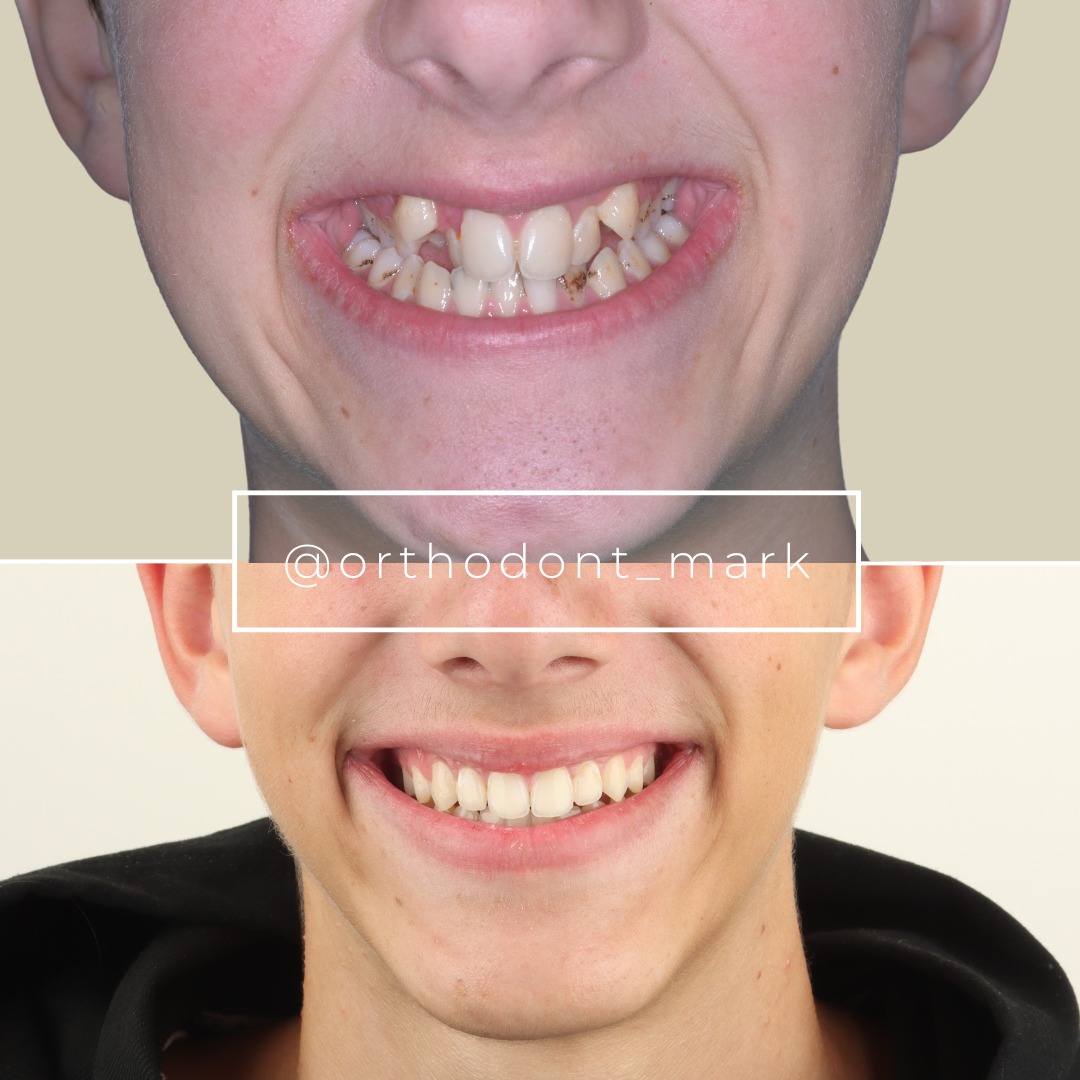
Initial situation
- Narrowing of the upper and lower jaw bases
- Supraposition (upward displacement) of the upper right canine
- Smile centerline displacement
- Displacement of the maxillary lateral incisors
- Crowding
- Partial crossbite
- Lack of interlocking (occlusal contact) in the right canine region
The decision
The case is shown here as a before/after outcome. The treatment plan followed standard staged assessment of the jaw base narrowing, canine supraposition, midline shift, and partial crossbite described in the initial presentation.
Combined jaw base narrowing and crossbite can be resolved together to reach a smooth, symmetrical smile.
The result
After treatment, the patient presented with a smooth and symmetrical smile.
Cases combining upper and lower jaw base narrowing with partial crossbite and canine supraposition often benefit from coordinated treatment planning that addresses transverse, sagittal, and dental factors together.
About skeletal expansion & MARPE
Combined narrowing of the upper and lower jaw bases can contribute to crowding, partial crossbite, and irregular canine position. In cases like this, clinicians typically assess transverse relationships between the arches before finalizing a treatment sequence, since correcting jaw base width supports resolution of crossbite and improves interlocking in affected regions such as the canine area.
Questions clinicians ask
What is a partial crossbite?
It refers to one or more teeth in a segment of the arch biting in reverse relation to the opposing teeth, rather than the entire arch being affected.
How are upper and lower jaw base narrowing typically addressed together?
Clinicians generally evaluate the transverse relationship between both arches so that correction of one base does not create a new discrepancy with the other.
What does 'lack of interlocking' in the canine region mean?
It describes an area where the upper and lower canines do not make proper occlusal contact, which is often related to the canine's position or the overall arch relationship.
Learn the decision-making behind cases like this
Get Dr. Mark Radzhabov's free guide to skeletal-expansion appliances — which appliance to choose at which age — plus a free introductory MARPE lesson.
Get the Free Guide →More clinical cases
Original case shared by Dr. Mark Radzhabov on Instagram @orthodont_mark · Published for professional education.