
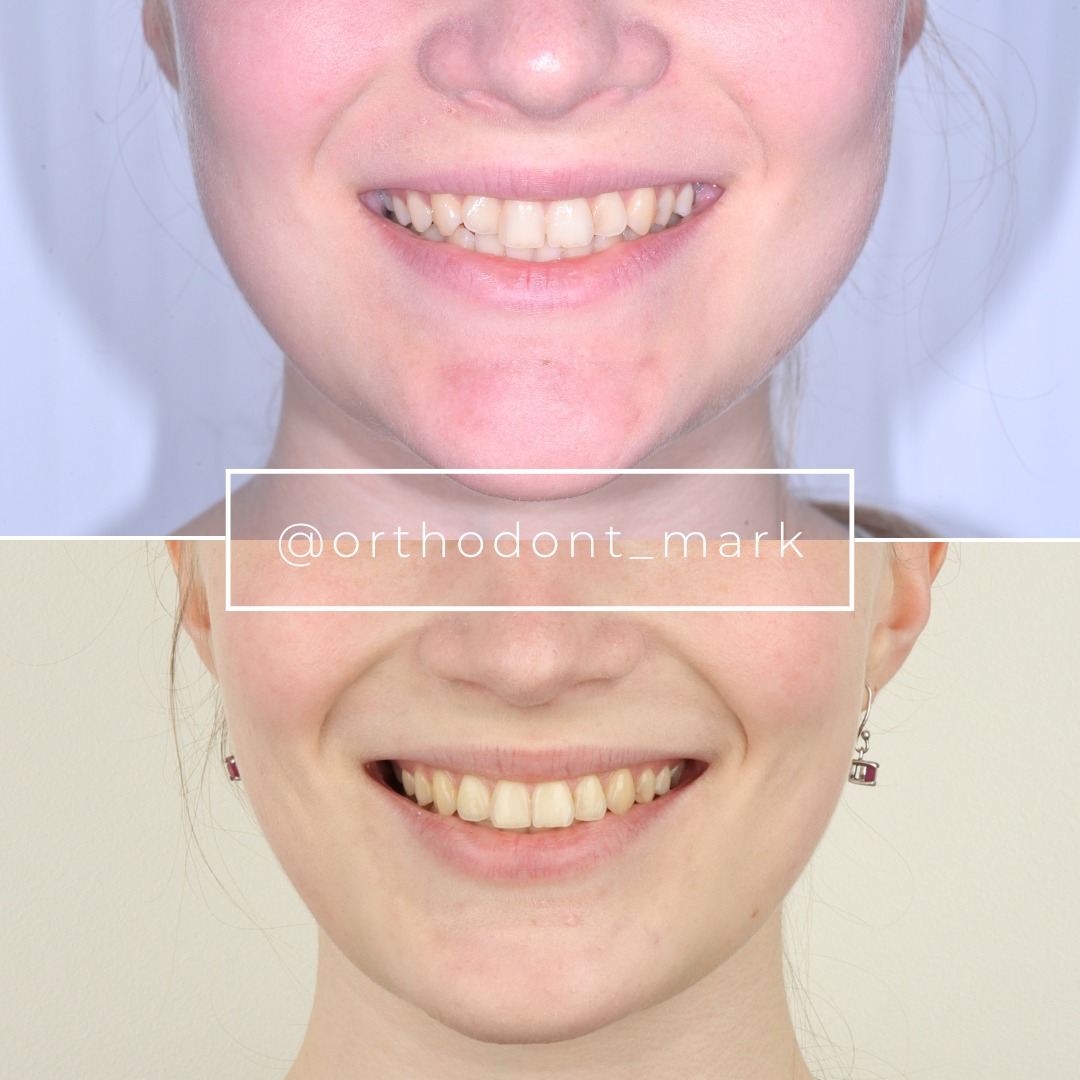
Initial situation
- Crooked teeth
- Shifted smile midline
- Early extraction of a permanent canine, affecting dental arch symmetry and occlusion
The decision
Treatment recreated space for the canine to correct the midline, create a broader, more symmetrical dental arch, and improve occlusal function. Invisalign aligners were used, beginning with approximately 30 aligners followed by two refinement stages. The patient also underwent implant placement in the canine area with soft tissue grafting and a temporary crown.
Recreating space for a missing canine can resolve a shifted midline while restoring arch symmetry and function.
The result
Treatment produced a harmonious, symmetrical, and esthetic smile. The full course of treatment took about 8 visits and approximately 3 hours of total chair time, including attachment placement and removal.
Midline correction tied to early canine loss can be addressed effectively by recreating canine space with aligner therapy combined with restorative and implant treatment.
About skeletal expansion & MARPE
A shifted smile midline linked to early canine loss is rarely a simple alignment problem; it usually reflects a change in arch symmetry that developed over years. In cases like this, clinicians typically evaluate whether recreating lost space, rather than closing it, offers the better long-term path toward both function and esthetics. Coordinating orthodontic space management with restorative and implant planning allows the midline, arch form, and occlusion to be addressed together rather than in isolation.
Questions clinicians ask
What caused the midline shift in this case?
Early extraction of a permanent canine affected the symmetry of the dental arch and occlusion, contributing to the shifted smile midline.
Why recreate canine space instead of closing it?
Recreating the space allowed correction of the midline, a broader and more symmetrical arch, and improved occlusal function, supported by later implant placement.
How long did aligner treatment take in this case?
Treatment began with about 30 aligners followed by two refinement stages, covering roughly 8 visits and about 3 hours of total chair time.
Learn the decision-making behind cases like this
Get Dr. Mark Radzhabov's free guide to skeletal-expansion appliances — which appliance to choose at which age — plus a free introductory MARPE lesson.
Get the Free Guide →More clinical cases
Original case shared by Dr. Mark Radzhabov on Instagram @orthodont_mark · Published for professional education.

