
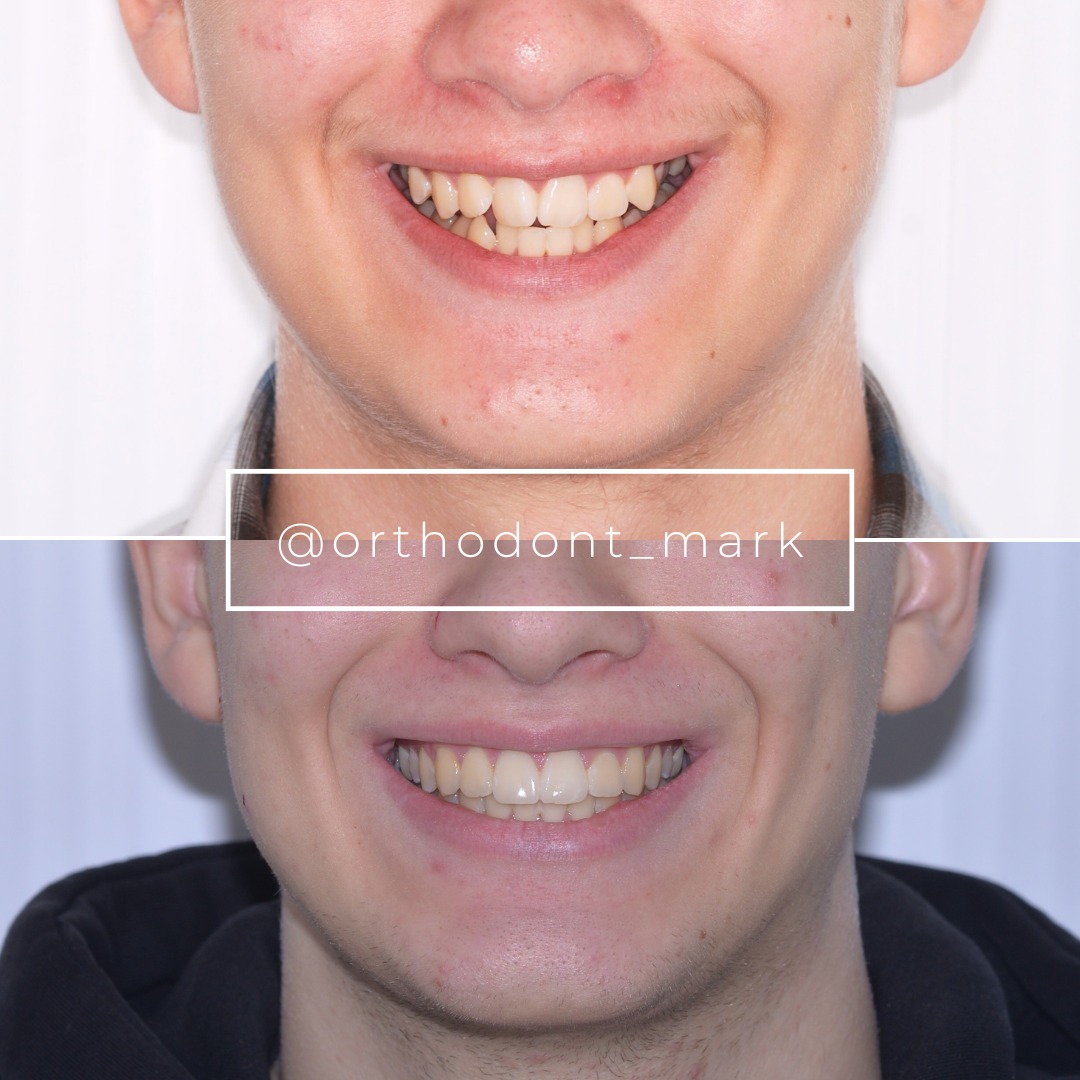
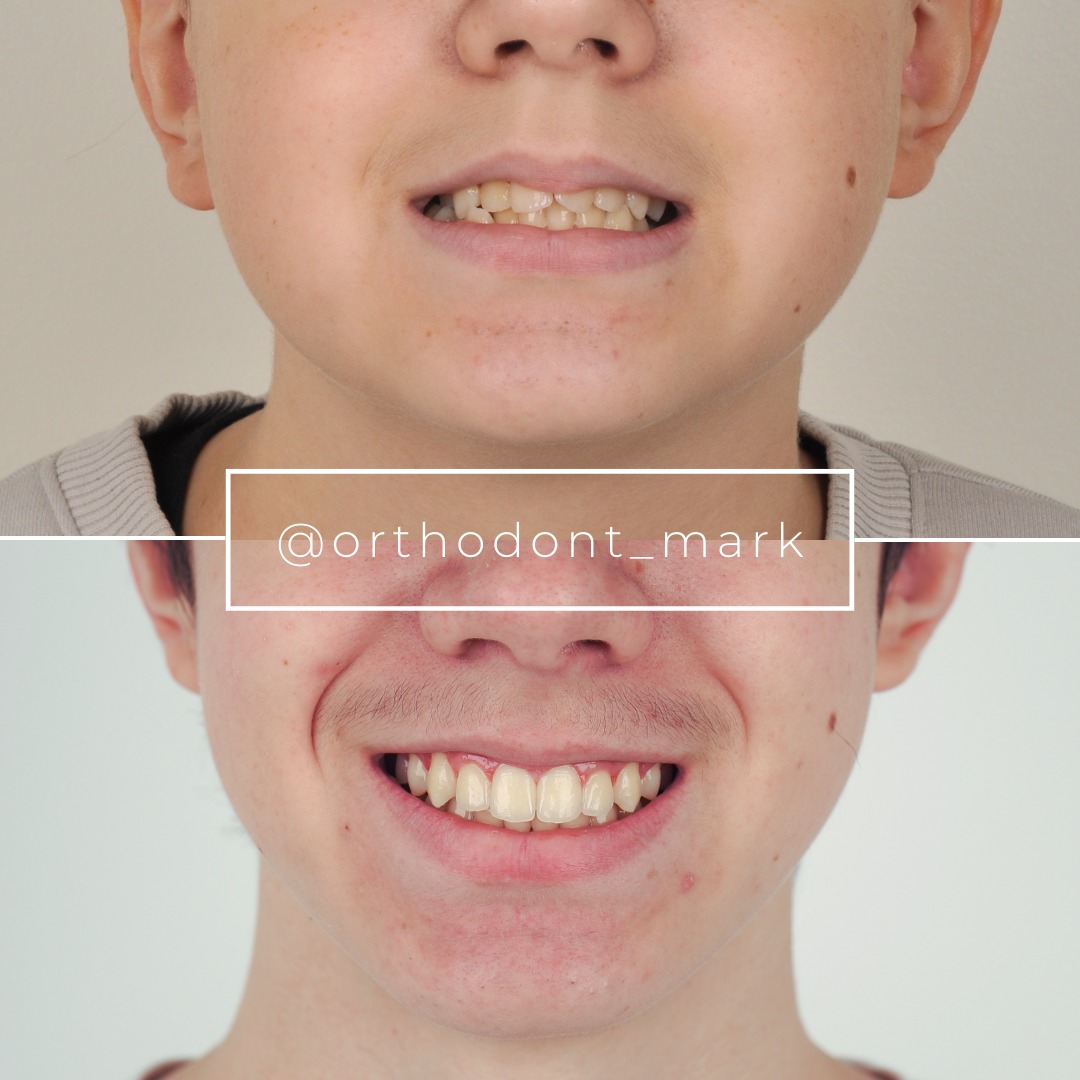
Initial situation
- Severe crowding of teeth
- Significant lack of space
The patient, still growing, was initially counseled on the possibility of premolar extraction on the upper jaw given the significant space deficiency.
The decision
A careful decision was made to begin treatment without extraction, using the Damon system with a gentle, gradual expansion. A follow-up assessment of upper and lower incisor inclination was planned in advance, with a transparent agreement that excessive protrusion would prompt a return to the extraction plan. When protrusion did form and was esthetically unsatisfactory to the patient, the decision was jointly made to proceed with premolar extraction.
A properly planned treatment that transitions to extraction mid-course is not a step backward but a path to long-term stability.
The result
The final result was harmonious, esthetic, and stable, achieved through a staged decision process that adapted the plan as the clinical picture evolved.
Building a transparent, pre-agreed decision point into a non-extraction plan allows a case to shift to extraction later, if needed, without compromising trust or long-term stability.
About skeletal expansion & MARPE
Severe crowding in a growing patient often puts extraction and non-extraction approaches in direct tension, and committing too early to either can create problems later. In cases like this, clinicians typically build a planned reassessment point into the treatment sequence, using incisor inclination as an objective marker for whether the non-extraction approach is holding up. Agreeing on that checkpoint with the patient in advance turns a potential mid-treatment change of plan into an expected, trust-preserving part of the process rather than a setback.
Questions clinicians ask
Why did treatment start without extraction despite significant crowding?
A careful decision was made to try gentle, gradual expansion with the Damon system first, given the patient was still growing.
What led to the switch to extraction?
A planned follow-up assessment showed excessive incisor protrusion that was esthetically unsatisfactory, which had been agreed in advance as the trigger to proceed with premolar extraction.
Was the extraction considered a treatment failure?
No; it was framed as part of a properly planned, staged process leading to long-term stability rather than a step backward.
Learn the decision-making behind cases like this
Get Dr. Mark Radzhabov's free guide to skeletal-expansion appliances — which appliance to choose at which age — plus a free introductory MARPE lesson.
Get the Free Guide →More clinical cases
Original case shared by Dr. Mark Radzhabov on Instagram @orthodont_mark · Published for professional education.

