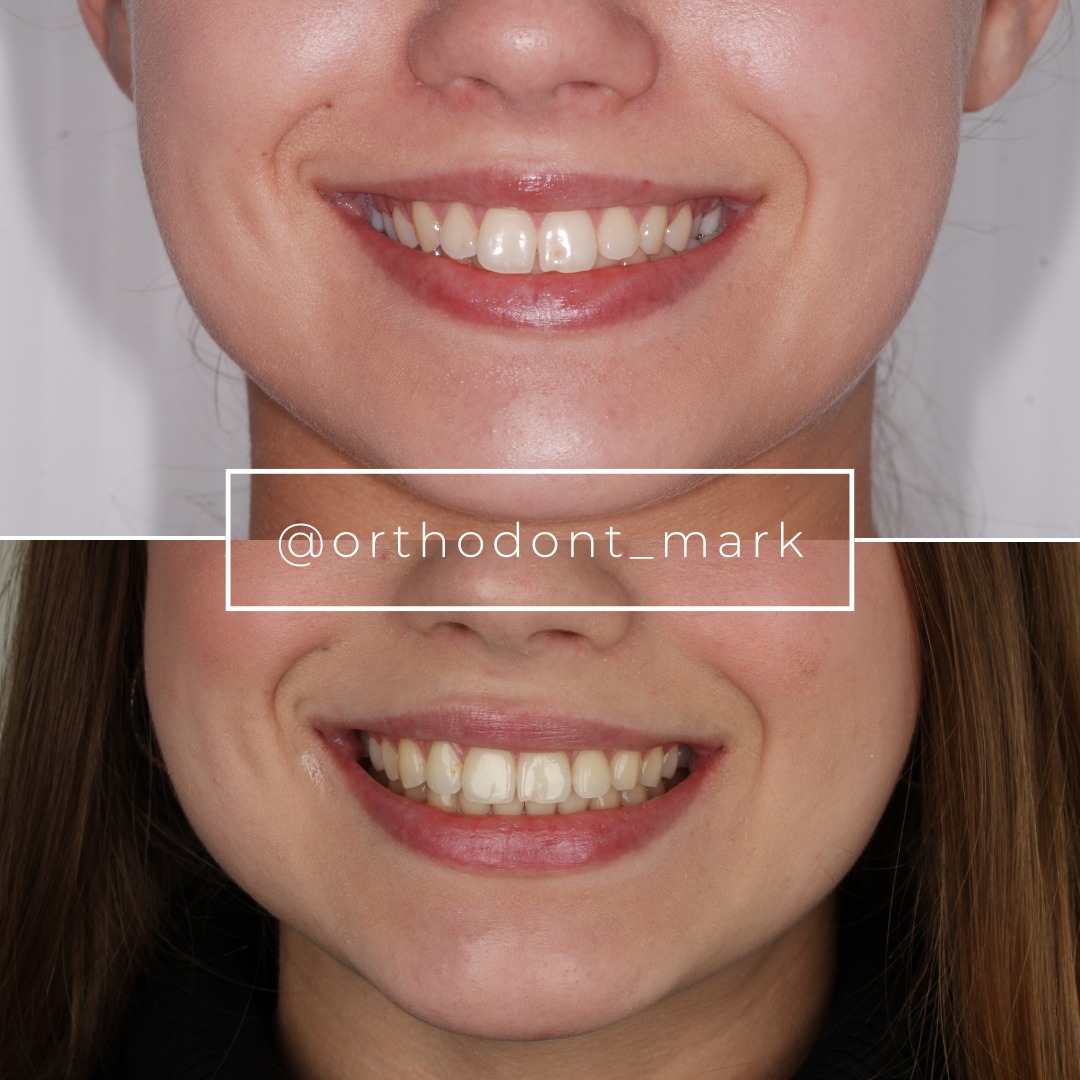
Initial situation
- Misaligned teeth and difficulty chewing
- Facial asymmetry in the lower third of the face with a shifted chin
- Diagnosis of skeletal Class III malocclusion requiring orthognathic surgery
The decision
Pre-surgical orthodontic treatment was carried out using Damon braces to prepare the arches, followed by orthognathic surgery and final bite correction. The entire process took about two years.
A skeletal problem needs a skeletal solution, pre-surgical orthodontics alone could not correct the underlying asymmetry.
The result
The combined treatment achieved a symmetrical face, well-aligned teeth, and a corrected bite, along with a significant improvement in the patient's confidence.
Facial asymmetry driven by a skeletal Class III discrepancy typically requires combined orthodontic-surgical treatment rather than orthodontics alone.
About skeletal expansion & MARPE
Although this case is corrected sagittally and vertically through surgery rather than by transverse expansion, it illustrates the same principle of matching the treatment modality to the skeletal, not just the dental, diagnosis. A skeletal Class III with facial asymmetry cannot be fully resolved by tooth movement alone, so pre-surgical orthodontic decompensation and orthognathic surgery are planned together from the outset. In cases like this, clinicians typically confirm the skeletal nature of a discrepancy before committing to a surgical treatment plan.
Questions clinicians ask
How is a skeletal Class III with asymmetry distinguished from a dental one?
A full diagnostic workup, including clinical and radiographic assessment, is used to determine whether the discrepancy originates in the jaw bones themselves rather than tooth position alone.
Why is pre-surgical orthodontics needed before orthognathic surgery?
Pre-surgical orthodontics decompensates the teeth so that after surgical repositioning of the jaws, the bite can be finished into a stable, functional relationship.
How long does combined orthodontic-surgical treatment typically take?
Timelines vary by case, but a combined process including pre-surgical orthodontics, surgery, and finishing often takes around two years.
Learn the decision-making behind cases like this
Get Dr. Mark Radzhabov's free guide to skeletal-expansion appliances — which appliance to choose at which age — plus a free introductory MARPE lesson.
Get the Free Guide →More clinical cases
Original case shared by Dr. Mark Radzhabov on Instagram @orthodont_mark · Published for professional education.