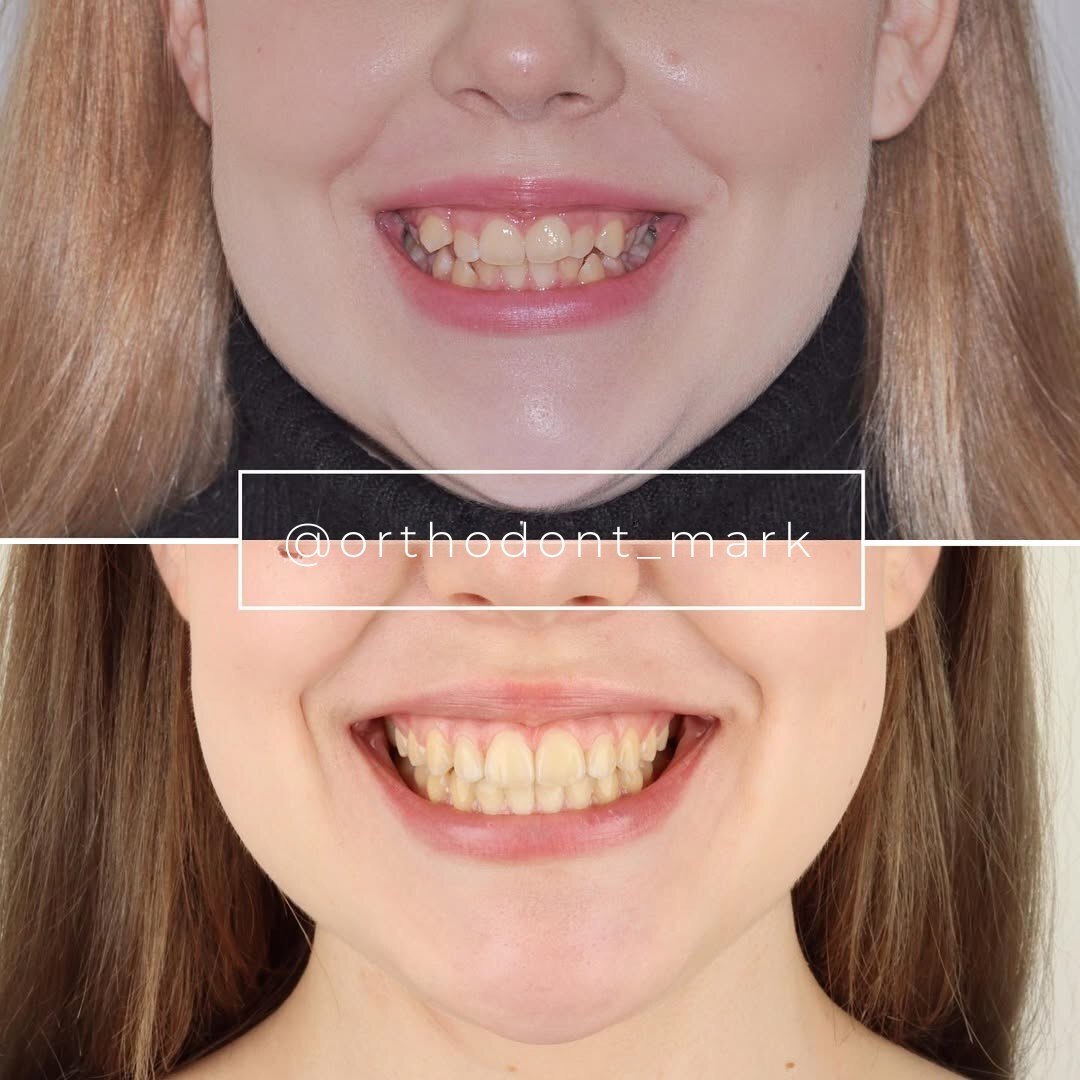
Initial situation
- Dental crowding
- Canine supraposition (upward displacement)
- Centerline displacement
- Broken symmetry of the dentition
- Excessive gingival display when smiling
The decision
The treatment plan addressed a combination of crowding, canine supraposition, and centerline displacement. Given the complexity of the presenting malocclusion, treatment spanned approximately three years to achieve a stable, symmetrical outcome.
Complex multi-factor malocclusions can require multi-year treatment to reach a stable, symmetrical result.
The result
The patient finished treatment with a wide, open, and symmetrical smile, with the canine supraposition, centerline discrepancy, and crowding resolved.
Cases combining crowding, canine supraposition, and centerline displacement may require an extended treatment timeline to achieve full correction.
About skeletal expansion & MARPE
Complex malocclusions involving crowding, canine supraposition, and centerline displacement often call for staged treatment planning rather than a single-phase approach. Clinicians assessing similar presentations typically evaluate arch space, vertical position of ectopic canines, and midline coordination before sequencing mechanics. Where transverse deficiency contributes to the crowding pattern, skeletal and dental expansion options are part of the differential planning discussion.
Questions clinicians ask
What does canine supraposition mean?
It refers to a canine that has erupted or is positioned higher than the normal occlusal plane, often contributing to crowding and an uneven smile line.
Why can crowding cases take several years to treat?
When crowding is combined with other issues such as centerline displacement or altered canine position, clinicians often need multiple treatment phases to achieve a stable and symmetrical result.
What determines the length of orthodontic treatment for complex crowding?
Treatment duration depends on the severity of crowding, the number of associated issues being corrected, and how the case responds to staged mechanics.
Learn the decision-making behind cases like this
Get Dr. Mark Radzhabov's free guide to skeletal-expansion appliances — which appliance to choose at which age — plus a free introductory MARPE lesson.
Get the Free Guide →More clinical cases
Original case shared by Dr. Mark Radzhabov on Instagram @orthodont_mark · Published for professional education.